i.o.cluster, also known as interference open cluster, is a simple Java framework that enables you to launch a distributed database service within your Java application, using JPA-like interface and annotations for structure mapping and data operations. This software inherits its name from the interference project, within which its mechanisms were developed.
i.o.cluster is a open source, pure Java software.
The basic unit of the i.o.cluster service is a node – it can be a standalone running service, or a service running within some Java application.
Each i.o.cluster node has own persistent storage and can considered and used as a local database with the following basic features:
operates with simple objects (POJOs).
uses base JPA annotations (@Table, @Column, @Transient, @Index, @GeneratedValue) for object mapping directly to persistent storage.
supports transactions.
supports SQL queries with READ COMMITTED isolation level.
uses persistent indices for fast access to data and increase performance of SQL joins.
allows flexible management of in-memory data for stable operation of the node in any ratio of storage size/available memory.
Each of the nodes includes several mechanisms that ensure its operation:
core algorithms (supports structured persistent storage, supports indices, custom serialization, heap management, local and distributed sync processes).
SQL and CEP processor.
event transport, which is used to exchange messages between nodes, as well as between a node and a client application.
Nodes can be joined into a cluster, at the cluster level with inter-node interactions, we get the following features:
allows you to insert data and run SQL queries from any node included in the cluster.
support of horizontal scaling SQL queries.
support of transparent cluster-level transactions.
support of complex event processing (CEP) and simple streaming SQL.
i.o.cluster nodes does not require the launch of any additional coordinators.
i.o.cluster implements the most simple data management model, which is based on several standard JPA-like methods of the Session object:
persist() - placing an object in a storage.
find() - find an object by a unique identifier.
execute() - execution of a SQL query.
commit() - committing a transaction.
rollback() - rollback a transaction.
As well, i.o.cluster software includes a remote client that provides the ability to remotely connect to any of the cluster nodes using internal event transport and execute standard JPA-like commands (persist, find, execute, commit, rollback).
Distributed Persistent Model
The interference cluster is a decentralized system. This means that the cluster does not use any coordination nodes; instead, each node follows a set of formal rules of behavior that guarantee the integrity and availability of data within a certain interaction framework.
Within the framework of these rules, all nodes of the interference cluster are equivalent. This means that there is no separation in the master and slave nodes system — changes to user tables can be made from any node. Also, all changes are replicated to all nodes, regardless of which node they were made on.
Talking about transactions, running commit in a local user session automatically ensures that the changed data is visible on all cluster nodes.
To include a node in the cluster, you must specify the full list of cluster nodes (excluding this current one).
Node Configuration Parameters
The minimum number of cluster nodes is 2, and the maximum is 64.
After configuration, we may start all configured nodes as clusters in any order. All nodes will be using specific messages (events) to provide inter-node data consistency and horizontal-scaling queries.
Rules of Distribution
All cluster nodes are equivalent.
All changes on any of the nodes are mapped to other nodes.
If replication is not possible (the node is unavailable or the connection is broken), a persistent change queue is created for this node.
The owner of any data frame is the node on which this frame has been allocated.
The system uses the generation of unique identifiers for entities (@DistributedId) so that the identifier is unique within the cluster and not just within the same node.
Data inserts are performed strictly in local structures, and then replicated changes (update/delete) can be performed only on the node-owner of the data frame with this record.
SQL Horizontal-Scaling Queries
All SQL queries called on any cluster nodes will be automatically distributed among the cluster nodes for parallel processing. Such a decision is made by the node based on the analysis of the volume of tasks (the volume of the query tables is large enough, etc.)
If a node is unavailable during the processing of a request (network fails, service stopped), the task distributed for this node will be automatically rescheduled to another available node.
Complex Event Processing
Interference supports complex event processing using the SELECT STREAM clause in the SQL statement. SELECT STREAM query supports three modes of CEP:
Events are processed as is, without any aggregations.
Events are aggregated by column value with using any of group functions (tumbling window).
Some window aggregates events for every new record (sliding window).
The basic differences between a streaming query and the usual one are as follows:
The execute() method returns a StreamQueue object.
The request is executed asynchronously until StreamQueue.stop() method will be called or until the application terminates.
The StreamQueue.poll() method returns all records previously inserted into the table and according to the WHERE condition (if exist) and continues to return newly added records.
Each StreamQueue.poll() method always returns the next record after the last polled position within the session, so that, provided that the SQL request is stopped and called again within the same session, data retrieve was continued from the last fixed position, in another session data will be retrieved from begin of the table.
Unlike usual, a streaming request does not support transactions and always returns actually inserted rows, regardless of the use of the commit() method in a session inserting data (DIRTY READS).
Especially when money is on the line and time is scarce, human decision making can be very flawed. Trading is one of the fields where erroneous and irrational behavior patterns are especially common. In this article, we’re going to look at the most common cognitive biases and irrational decision making patterns, and how to avoid them.
Being aware of these thinking flaws has two main advantages. Firstly, it helps you avoid them in your own trading, and secondly, it can help you identify and explain seemingly irrational market behaviors caused by these biases.
Most of these so-called cognitive biases were discovered and introduced by the Nobel prize-winning Daniel Kahneman and Amos Tversky.
(1) Gambler’s Fallacy
(2) Winning Streaks
(3) Confirmation Bias
(4) Law of Small Numbers
(5) Survivorship Bias
(6) Correlation does not imply Causation
(7) Hindsight Bias
(8) Recency Bias
(9) Attribution Bias
(10) Sunk Cost Fallacy
(1) Gambler’s Fallacy
The first cognitive bias that I want to talk about is the gambler’s fallacy.
The gambler’s fallacy is incorrectly over or understating the likelihood of an event based on a series of past events. This can be illustrated with a simple example of a coin flip. The probability that a coin will land on heads is 50%. No matter how often you flip a coin, this probability does not change. So even if your coin just landed on heads 10 times in a row, this does not affect the probability of the next coin flip.
As the name implies, the gambler’s fallacy is especially common in gambling. When a roulette wheel ended on red for the past 10 rounds, people prefer betting on black even though the odds of red and black are identical.
This pattern of thinking is quite common in trading as well. Let me give you two examples.
Have you ever opened a long position because a stock had many consecutive down days or vice versa? If so, you have fallen prey to the gambler’s fallacy.
Another example would be the reaction to losing or winning streaks. If you ever felt that after many consecutive wins, the chances of losing increased and you decreased your position size, you have been guilty of the gambler’s fallacy.
The odds of winning on a trade don’t magically change just because you had multiple losses or wins before this trade.
(2) Winning Streaks
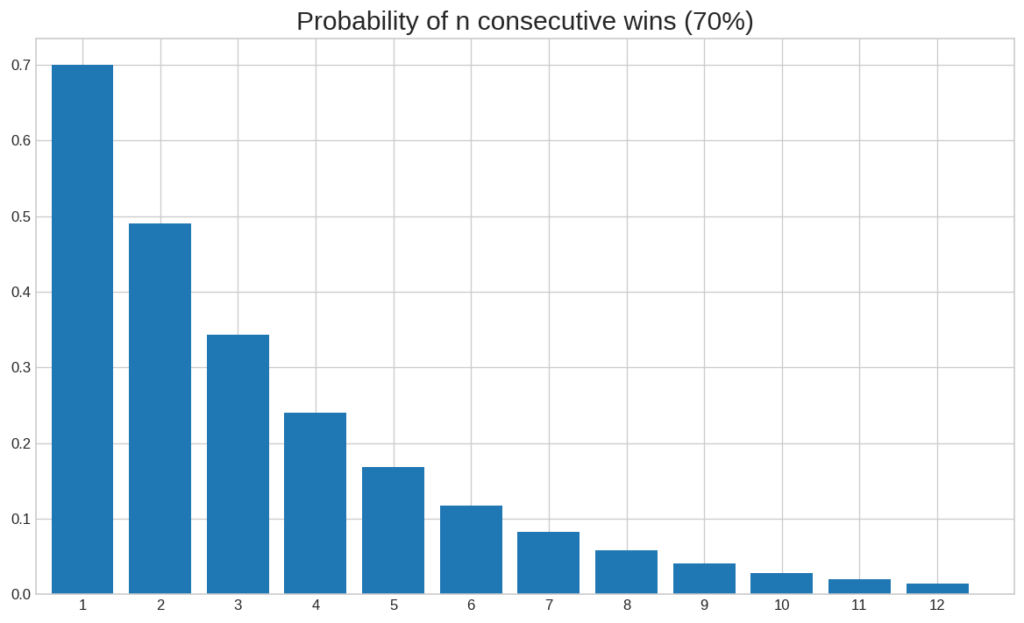
Speaking of winning streaks, if we assume that you have found a trading strategy that guarantees you a 70% chance of winning on every single trade, what do you think the odds of winning 10 times in a row are?
The answer is under 3%.
In fact, even the probability that you will have 2 consecutive wins with this strategy is under 50%. This means that it is less likely that you will have 2 consecutive winners than that you won’t.
And remember, this is with a strategy that guarantees you a 70% chance of success on each trade. Most strategies won’t have nearly as good odds.
Here is a diagram that shows the probability of different-sized winning streaks for this strategy.
To calculate the probability of n consecutive wins, you simply have to take the estimated odds of your trading strategy to the power of n. Note that this assumes that your trades are independent of each other and the probability of winning is constant. Whether these assumptions are realistic is a topic for a different article.
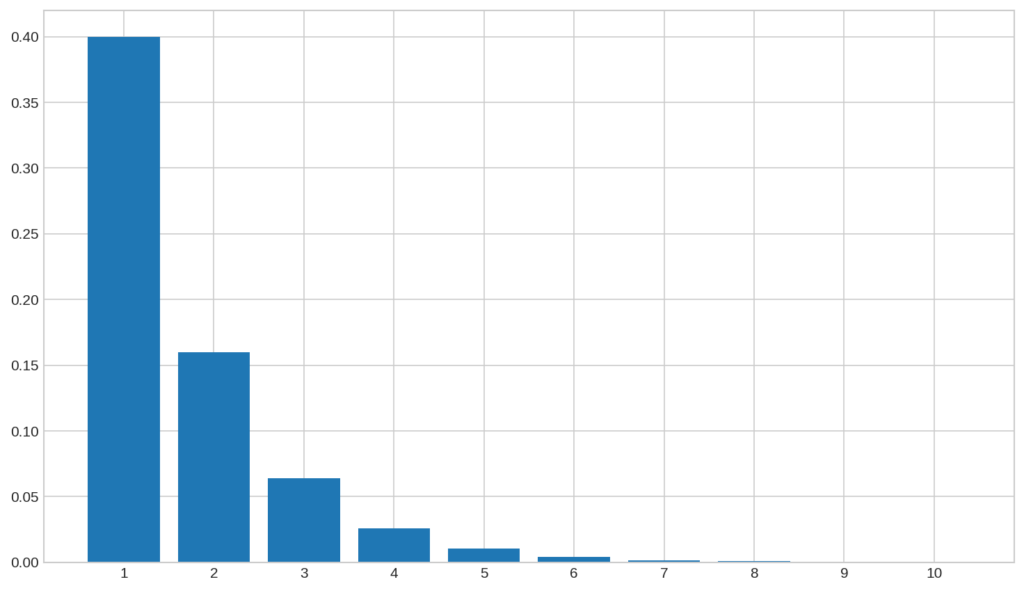
If we take a look at the odds of losing streaks, we get a similar picture. Here is a diagram that shows the probabilities of multiple consecutive losses with a trading strategy that has a 40% chance of losing on any single trade.
As you can see, with a 40% chance of losing, it is extremely unlikely that you will have more than a handful of losses in a row.
So what can we learn from this?
Firstly, no matter how good your strategy is, losses do happen. You can’t win all your trades. Therefore, you have to implement solid risk management practices and keep the size of your losses under control.
Next up, the odds of having many losses or wins in a row is quite low. So if you often have more than 10 major consecutive losses, you should seriously start doubting the quality of your trading strategy.
But always remember, even though the probability of winning 10 trades in a row is very low, the probability of winning on any single trade is not lower just because you won on the last 10 trades.
(3) Confirmation Bias
Next up, let’s take a look at our next cognitive bias, namely the confirmation bias. Confirmation bias is the tendency to seek out information that confirms your preexisting beliefs. This is a bias that without a doubt, the vast majority of traders have been guilty of.
After opening a trade, it is only natural to continually seek out information that confirms your trade idea. You might look at dozens of indicators and social media posts and only focus on those that confirm your beliefs. Finding something that agrees with you is a good feeling and certainly can boost your confidence in that position. The problem is that by doing this, you often ignore signs that your trade wasn’t the best idea and something might be wrong. Instead, you convince yourself more and more that everything is fine. By searching Twitter for a ticker symbol, you are almost guaranteed to find at least a few people that have the same market assumption as you.
One way to avoid confirmation bias in trading is by having a clear set of indicators and rules to follow for your trades. If you have such a clear set of rules and indicators, there is no need to go look for any other confirming signs. Furthermore, it is best to avoid social media as a trade decision making guide.
(4) Law of Small Numbers
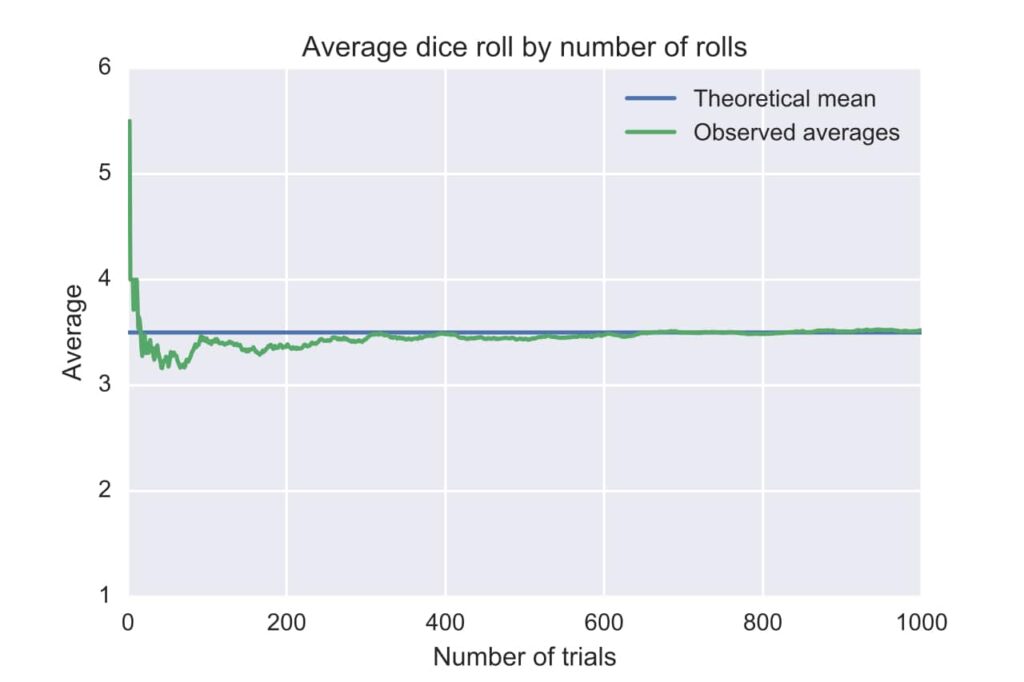
That said, let’s move on to our next fallacy. The next fallacy is the law of small numbers. You might have heard about the law of large numbers that states that the average of growing sample sizes converge to the actual mean of the total population.
Here is a graph that shows this convergence on the example of a dice roll.
This is a very powerful rule in probability theory that allows you to estimate a population’s parameters with large enough samples. But as the name implies, this only works for big sample sizes. This is where the fallacy of the law of small numbers comes into play. Most people intuitively use the law of large numbers incorrectly, namely with way too small sample sizes.
Let me give you an example.
Have you ever tried a trading strategy for a handful of trades and then concluded that it doesn’t work. If so, you have been guilty of using the law of small numbers. A few trades is not a big enough sample size to give you any significant information about the quality of a trading strategy.
Let me tell you how you can avoid the law of small numbers by showing you how to efficiently test the effectiveness of a trading system:
The goal is to use this trading system for at least 20 trades. It might seem scary to use a new trading system for over 20 trades when you have no idea how good or bad it might perform. Therefore, you should trim down your risk to a level so that you could easily afford to lose on all of these 20 trades. Your goal with these trades is not to make money, but to test out a given strategy.
When making these 20 trades, try to be as mechanical as possible. Create clear rules for every market scenario imaginable and follow these rules on every trade. If you don’t have a clear set of rules to follow, you can’t reliably test your strategy since there is no strategy to test.
Furthermore, make sure to keep a detailed and thorough trade journal. After every trade, track entry price, exit price, profit potential, money at risk, time in the trade, and more. If you want a detailed guide on how to create the most effective trade journal, check out my article on the best trade journal software.
After you have followed these steps for at least 20 trades, you are ready to evaluate the strategy. Ideally, you should now have a rich collection of data on this strategy to evaluate it and make an informed decision on how effective this trading system is.
I know that this might seem like a lot of work just to test a trading system, but without having a big enough sample size, you can’t really evaluate anything.
The goal of this example was to illustrate how you can make informed decisions based on a collection of data. Besides testing a new strategy, this approach can be used for other decisions as well.
Making a decision based on one or two occurrences is like saying roulette has a 100% win rate because you won one round.
(5) Survivorship Bias
The next cognitive bias that we are gong to look at is the survivorship bias.
Wikipedia defines survivorship bias as:
“The logical error of concentrating on the people or things that made it past some selection process and overlooking those that did not, typically because of their lack of visibility.”
Let’s, once again, look at a couple of examples to better understand what this means.
If you look around, it is easy to arrive at the conclusion that most ETFs, mutual funds, and even individual stocks go up over time. But, in reality, that is an erroneous conclusion. That’s because the universe of funds and stocks that you look at is already skewed in one direction. One reason why a stock did not go up but instead fell is that it went bankrupt. And a bad performing fund usually gets closed after a few years.
In other words, only those funds survive that performed well enough. So when you say that most stocks or funds go up over time, you aren’t considering all those that didn’t survive. Therefore, the results obtained by only looking at survivors can be very flawed.
To give you some data, a Vanguard Group study recently found that a 1997 investor in a large-cap growth or value fund only stood a 22% chance of finding a fund that would survive and outperform its benchmark 15 years later. Out of the over 5000 available funds, only 54% survived of which 19% outperformed their benchmark. The reminaing funds either got merged or liquidated.
The problem of only considering a universe of investments that survived a certain selection process is especially common when backtesting and analyzing trading strategies on historical data.
But also when analyzing success stories outside of trading, survivorship bias can be a big problem. The results of looking at shared traits of highly successful people doesn’t actually yield very significant results. Typically many unsuccessful people also share these traits but they weren’t considered in such a study which can dramatically skew the results.
Often successful people succeed in spite of certain traits, not because of them.
The phrase that history is written by winners very much also applies to business and financial markets.
In general, when looking at and analyzing investments, make sure to think about what you can’t see. Is there a seemingly invisible filter that you are missing? If so, your results can be vastly skewed in an unwanted direction.
(6) Correlation does not imply Causation
This brings us to our next common fallacy, namely mistaking correlation for causation. Correlation does not imply causation, but sadly it is often treated as if it does. There are different types of this fallacy. I will now cover 3 of the most prominent causation fallacies.
The first is reverse causation. An easy example of this is the correlation between rainy days and the usage of umbrellas. When it rains, people tend to use umbrellas much more. Does that mean that using umbrellas causes it to rain?
Of course not, it’s the other way around.
This might seem like an obvious mistake, but often things aren’t as clear. If, for instance, stock A and B are heavily correlated, does that mean that an up move in A’s price causes a rection in B’s price or the other way around?
Another causation bias is neglecting the fact that a third variable might be the cause of two correlated variables. For example, two oil stocks might be highly correlated. But this doesn’t mean that a move in one of the stocks causes a move in the other stock. Instead, a third variable, namely the price of oil might be the cause for the moves in both of these stocks.
Last but not least, two variables can also be correlated without having any causal link. In fact, if you have a big enough set of data, you are almost guaranteed to find some variables that are correlated purely by chance. One example of such a coincidental correlation is the correlation between the per capita consumption of chicken and US crude oil imports. These two variables have a historic correlation of almost 90% over about 10 years. Nevertheless, I wouldn’t use chicken consumption data to try to predict US crude oil imports.
There are countless similar examples of seemingly nonsensical correlations. So going forward, never assume that correlation means causation. Proving correlation is very straightforward, but proving causation is a totally different story.
(7) Hindsight Bias
With that being said, let’s move on to the next cognitive bias, namely hindsight bias. Hindsight bias is the tendency of overstating the odds of an event that has already happened. Here is a great quote from Nobel prize-winning Daniel Kahneman about hindsight bias:
“A stupid decision that works out well becomes a brilliant decision in hindsight.“
— Daniel Kahneman
In my opinion, hindsight bias is especially common amongst traders. Way too many traders evaluate the quality of their trades based on their outcome. This is a very flawed way of evaluating your trades. A trade that has a 70% chance of making $200 and a 30% chance of losing $100 is without a doubt a great trade, no matter its outcome. Even such a trade won’t work out 3 out of 10 times, but that doesn’t make it a bad trade. Sadly, this is how many traders evaluate their trades.
Hindsight bias is also one reason why technical analysis seems so attractive. Finding chart patterns on historical charts is very easy, but without the benefit of hindsight things aren’t nearly as easy.
If you ever felt that a past price move seemed so obvious, you have fallen prey to the hindsight bias.
To avoid hindsight bias, you need some way of evaluating your trades not based on their outcome. Instead, you should focus on the quality of your decisions along the way. Did you have a clear trade plan and strategy? If so, did you follow it? If not, why not and what could you do better next time?
In general, it is best to have a consistent way of evaluating your trades that is not affected by the outcome of your trades.
(8) Recency Bias
Another common bias is the recency bias. Recency bias the illogical way of putting more weight and importance to recent events compared to historical ones. This can easily be observed by looking at the cyclical nature of markets. The longer a bull market is, the more and more people forget that prices don’t only go up. Thus, investors pay less and less attention to their risk even though it should be the other way around since the further prices rise, the more they can fall.
The same is the case directly after market crashes. This is when people typically overmanage their risk because they overestimate the odds of future drops. This can be a great time to sell overpriced insurance products such as options and volatility.
(9) Attribution Bias
A different bias that can be observed in the trading news business is the attribution bias. The attribution bias is the bias of constantly trying to assign some reason to an event, even if your reason has nothing to do with reality. Financial news companies are in the business of satisfying this bias. They seem to have an explanation for every single price move even if their explanations sometimes are contradictory.
Sometimes, you can’t break down a price move into a simple cause and effect relationship. But this doesn’t stop us from trying. The problem is that humans are very good at finding an explanation for almost anything even if the explanation doesn’t make sense. Basing trades on these explanations can do more harm than good.
So make sure to be careful when looking at the reasons that financial news organizations assign to certain price moves.
The best explanation for an up move will always be that there simply are more buyers than sellers.
(10) Sunk Cost Fallacy
Last but not least, let’s briefly look at the sunk cost fallacy. If you ever have held on to a position far longer than you should have, you have been guilty of this fallacy. The sunk cost fallacy is the tendency to refuse to stop an action because you have already sacrificed a good amount of money and/or time into it. Sometimes, it is best to just cut your loss than to further waste money and time on a project or trade. Sunk costs should not be a reason for you to continue staying in a trade.
If you wouldn’t open your trade at its current price level, you should not stay in it, regardless of how much you already have lost.
One way of combating the sunk cost fallacy is by having a clear trade plan with clearly defined exit points before you enter a trade.
How to Avoid Cognitive Biases in Trading
We have now covered a wide variety of different cognitive biases that can dramatically impact your trading and decision making in general. Let us now briefly look at how you can avoid these biases.
First and foremost, it is already a good step in the right direction to be aware that these biases exist. But sadly, simply being aware isn’t enough to completely avoid them. In fact, it is almost impossible to fully eliminate these biases from your life since they are so deeply ingrained in your human psychology. That said, you can definitely do things that can reduce the frequency of them and thereby improve the quality of your decisions.
One thing that can dramatically increase the likelihood of using a cognitive bias is trying to make decisions under time pressure. So avoiding time pressure is another step in the right direction. One way of avoiding time pressure in trading is by preparing beforehand. Instead of trying to improvise and rely on your intuition, always have a clear trade plan before you open a trade. The trade plan should have all the information you need to mechanically carry out your entire trade.
I highly recommend checking out my trade entry and exit guide in which I breakdown how to create an effective trade plan.
Besides having a trade plan, a good trade journal is another way for you to improve upon your decision making and trading.
Otherwise, try to actively monitor yourself for these cognitive biases. Especially in situations where the likelihood of a bias is high, step back and rethink the entire situation from another perspective.
Furthermore, avoid making important decisions when you are in a bad mood or not fully focused due to a lack of sleep, for instance.
In my estimation, I have given over 2,500 interviews in my career, the bulk of them for Software Engineer positions. I have been interviewing Software Engineers for over 25 years and in my current role as CEO of Solution Street, I conduct, on average, two interviews a week. Solution Street has been evolving its interview process for over 18 years, and we feel like we offer a pretty robust and fair process. In this article, I will give you the tips you need to put your best foot forward and succeed in your next technical interview.
Do’s for a Software Engineer Job Interview
First, let’s talk about interview Do’s. Based on my experience, here is my list of the top seven things you should absolutely Do!
Research the company and people you are interviewing with. Spend some time looking at the company website, the interviewer’s background information (if available), and see if they have written any articles/blog posts. Make sure you know what the company does (what do they build/make/sell?) as well as the interviewer (what is their role?).
Prepare key questions you would like to ask. Your questions should be specific to the company and interviewer(s). Typical questions here are: What type of work do you do? How are the teams made up (cross functional or by function)? What technologies do they use? How is the work-life balance? What are the company's core values and are they real? What are the company’s goals?
Show up 15 minutes early! Don’t be late; if you get there more than 15 minutes early, wait in your car, or in the nearest cafe. If you are going to be late, let them know (but don’t be late!).
Dress to impress. Even if the company is casual, you should dress nicely. You don't need to overdress based on the company's dress code (you should ask about this before your interview), but you should present your best!
Smile. Smile, smile, and smile some more!
Listen carefully. Repeat the question back if you are not sure. I can’t tell you how often we have eliminated a candidate from consideration because they just refuse to listen during the interview. Answer the questions simply and don’t go on and on unless prompted. How well you listen in the interview is a good indicator of how well you will listen in the job!
Be honest. If asked something you don’t know, say, “I don’t know that.” If, however, you know something close, offer details of that if they are interested. For example, if asked if you know Angular, but you only know React, you should say, “I haven't used Angular before, but I have used React and I have done some reading and I feel like I could come up to speed on Angular very quickly.” Express how you are a hard worker and willing to put in extra time on your own time to learn the technology. Don’t cheat; you may be tempted in an online interview to Google the answer - don’t do it!
Don’ts for a Software Engineer Job Interview
Now that we have covered the Do’s, let’s cover the Do NOTs! Here are 10 things that you should never do during an interview (yes, I have actually seen all of these!).
Chew gum. Chewing gum in an interview is never professional!
Bring your phone. Unless you have a sick family member or a spouse about ready to give birth, leave your phone in the car. If you need to bring your phone, explain why ahead of time and make sure you block out all other callers.
Wear jeans. Even in a casual environment, you should wear slacks or a dress to an interview!
Mumble. Some of us talk louder than others. If you are a soft talker, practice with a friend to appropriately increase your volume. You need to be able to speak clearly and concisely. Silence is perfectly okay; don’t feel the need to fill the void with ums and hmms and whatnots…
Be stoic. Be passionate, animated, energetic...drink a cup of coffee before the interview if you need to, but don’t go overboard!
Badmouth anyone or any company (or any technology). Be Switzerland. If you’re asked why you left a company, you can say you weren't being challenged, or it wasn't a fit, but don't say “that company sucks,” or “those guys are jerks” (even if they are).
Ever rate yourself 10 out of 10 for anything (unless you invented it). Let's say you consider yourself a really great Java developer. In an interview, if you're asked to rate your Java programming skills and you say they are a 10 out of 10 but you miss one or more questions about Java, the interviewer will feel that you overrated yourself. But if you rate yourself as an 8 out of 10 and you miss one or none of the Java questions, the interviewer will think...wow, this person is great and humble! When asked to rate yourself, be honest and fair, err on the side of “under-rating” yourself.
Wear dangling/large bracelets or fidget with your pen. Clunky bracelets can be a noisy distraction if you are asked to code as part of the interview and your jewelry continually clunks against the computer keyboard or table. Similarly, fidgeting can be a big distraction. For instance, I interviewed someone who clicked their pen open and shut about 50 times during a 1-hour interview...all I could think of was the pen!
Lie on your resume. Don't even exaggerate, be humble and honest.
Tell the interviewer that you don’t like this kind of work. The interview is not the place to say that your real passion is something completely different and you just do this to pay the bills. Even if this is true, it is not something you should bring up in an interview.
10 Steps to Succeed in a Live Coding Exercise
Now that we have covered the key Do’s and Don’ts of interviewing, many Software Engineer interviews include a live coding exercise. When doing a live coding session, here are my 10 steps to success!
The first step is to repeat the question back to the interviewer(s). Make sure you understand the directions. If the interviewer(s) shares the program problem on the screen or paper, try to resist going directly to reading it. First, listen to the person describe the problem; once they pause, then you can read the problem yourself and repeat it back to them in your own words. Take a deep breath and try to relax!
Make sure you understand the time restrictions. Know how long you have to do the exercise. If you're not sure, ask how long you have to complete it.
Write the signature first. Outline the function calls and parameters passed. If you prefer solving on paper, that is okay, just make sure you ask the interviewer.
Talk through the problem. As you are solving it, ask questions.
Start with pseudocode as comments. Then build as you go.
Code what you know first. The rest will come.
Test the solution. Test out the solution in front of the interviewer(s).
Refactor the code. Do this if given time.
Use good variable names from the start.
Add comment documentation to methods/classes/functions.
I am often asked how to prepare for questions that might be asked during an interview. Software Engineer interview questions vary tremendously from company to company, so it is very hard to know exactly what will be asked. I recommend you start by taking a close look at the job description. Here is a sample job description from my company’s website:
Preparation Process for an Actual Job Description
Solution Street has a great opportunity for C#/ASP.NET developers with a strong background in software design and development having worked on multiple projects over their career with the following experience: 5+years .NET development experience Oracle PL SQL Ability to work with minimal supervision Excellent communication skills *This position is currently remote, but candidates should be local to the Northern VA, DC area.
From reading this, the interviewee should be prepared to be asked about the following in an interview for this position:
C# - What are the fundamentals of the language, and what are typical mistakes folks make using the language? If interviewing for a junior position, you should know the basics of syntax, variable scoping, iterators/loops, assignments, basic Object Oriented constructs. For a mid-level position, possible questions might include namespaces, overloading, more advanced Object Oriented concepts (inheritance, polymorphism, abstraction). For an advanced position, topics might include more architectural concepts, memory leaks, garbage collection, performance, threading and lambdas.
ASP.NET - Here you probably need to know more about the version they are looking for (good question to ask in the initial screen); once you know that, you can get a better idea if this is legacy code base asp/spaghetti, webforms, MVC or .NET core. For each of these, you should know how they work, be able to do an implementation in front of someone, understand the framework, the lifecycle, conventions and configurations. Ideally, you would be able to compare these; what can you do with .NET core that you can’t with .NET MVC? (Core is cross platform.)
Oracle PL SQL - Again, it’s probably a good idea to know what they are looking for here before the interview; do you need to be able to design tables and relationships? Or do you just need to be able to write SQL? How about stored procedures, do you need to be an expert at these?
Minimal supervision - This says they are looking for a self-starter, someone who can troubleshoot problems on their own, someone who can ask the right questions to solve the problems presented. Be prepared for questions like “What would you do if you didn’t have any work assigned to you?” and “What would you do if you hit a blocker?”
Excellent communication skills - This says they want you to be able to communicate well with the team both verbally and in writing. Can you articulate something complex in a way that is easy to understand? You may get a question about how you would explain big endian byte order to your grandmother.
So reviewing the job description can usually help you prepare for the types of questions in the interview, but there are sometimes when the job description is just plain wrong, or the interviewer is not as familiar with the job description as they should be, or they are just “winging it.” So you may get some random questions out of left field that you are totally not expecting. The best way to deal with an unexpected question is to try to understand why they are asking it. For example, if you were interviewing for the position advertised in the job description above and you were asked how well you know Angular (which is not mentioned in the job description), you might reply with the best answer you can...which could be "I really haven't had a chance to use Angular, but I would love the opportunity to!” This sounds way better than “I don’t.” But after you answer, you can say, “I didn't notice Angular in the position description. Are you considering moving to Angular for the front end of this system?” This can trigger a good dialog.
Some interviewers don’t have a ton of experience so they just Google “top interview questions for Java developers” or “top interview questions for React developers” depending on the job position, and use the first few questions they find. So it’s not a bad idea for you to do this since you'll be prepared if they happen to do this!
Some interviewers use a probing technique; they ask a question and if you answer it well, or seem knowledgeable in a specific area, they continue to ask more and more detailed questions until they either run out of questions or you run out of answers. For this style, a great option for the interviewee is to not just answer, but give examples of how/when they used the technology or technique they are asking about.
Lastly, some interviewers like to ask brain teasers or math questions, or big idea/thought questions. Big tech companies are famous for questions like “How would you move Mt Fuji?” or “How many gas stations are in the USA?” The important thing here is not to get flustered and to take up the challenge and show your analytical thinking and problem-solving skills. Clarify the probing questions and come up with ideas and the pros and cons of those ideas.
3 Tips for an Online Interview
During this COVID-19 time, most interviews are being done online, so I have a few hints for online interviews that will help you out:
Make sure you have a good set of headphones with a microphone. Using your laptop mic has a good chance of not sounding well and having feedback from your speaker.
Make sure you have solid bandwidth for the interview and test the tools you will be using ahead of time. In a recent interview, the interviewee had very bad audio and video and the connection kept dropping. At the end of the interview, I asked the individual to run a speed test that showed a throughput of less than 1 MB/second which was a surprise to this person who didn't know why it was so bad.
Find a quiet place free of distractions and interruptions. We have all had our kids or our pets interrupt us during these times which is fine for normal business, but for an interview, you really need to find a quiet place.
I hope my recommendations for a smooth interview process, including my list of do's and don'ts, suggestions for a successful live coding session and how to prepare for interview questions, and tips for online interviews have been helpful. If you have other suggestions, drop a comment, we are always trying to improve!