Translate

Thursday, February 4, 2021

8 YouTube Channels for DevOps Professionals

 Source: https://dzone.com/articles/8-youtube-channels-for-devops-professionals

8 YouTube Channels for DevOps Professionals

If you're a DevOps professional, this article suggests 8 DevOps channels where you can find useful resources to keep up with the latest changes and adaptations.

  · DevOps Zone · News

Learning DevOps is an ever-lasting process that involves a lot of changes and adaptations. We keep seeing industry updates that we need to incorporate into our everyday activities. One of the best sources for DevOps news and fun facts is YouTube. By following DevOps YouTube channels, you can find out about industry trends, see how new products work, and get a closer look at some DevOps practices.

These are the 10 DevOps YouTube channels that we think you should follow in 2021. 

Bret Fisher Docker and DevOps

Bret Fisher’s channel is a fun place where you can learn a lot about Docker, containers, Kubernetes, and the cloud. He has some really interesting discussions around topics that interest developers, sysadmins, and many other IT professionals. As he says, his videos are “a bit more fun than what you’re used to for tech videos.” 

If you want to become a container expert, you can also check out Bret’s website and enroll in some of his DevOps courses. Here’s one of my favorite videos from his channel: 

TechWorld With Nana

This is one of the DevOps YouTube channels where you can get familiar with the core concepts even if you’re a complete beginner. Nana is an Austria-based engineer who focuses on creating content around Kubernetes, Docker, Jenkins, and other DevOps technologies. Her videos are very fun and easy to understand. 

If you want to get familiar with her you can follow her on Twitter, and also check out her Dev.to blog. One of her greatest posts is her free Kubernetes course. She also made a 3-hour-long Docker tutorial for beginners: 

Stephane Maarek

Stephane Maarek’s channel focuses on tutorials and information about Apache Kafka and AWS Cloud. Here, you can find videos about setting up your AWS budget, setting up Kafka on Prometheus, AWS solution architecture discussions, Zookeeper, EC2 basics & instances, AWS IAM, and many other topics. 

Stephane also has a Data Cumulus website, where you can find various courses to prepare you for AWS Certifications. Moreover, you can learn about Kafka, data engineering, and building APIs. His courses have been passed by over 500k students, many of them saying that the material is engaging and easy to understand. 

You can follow Stephane on Twitter or visit his Medium blog. Here’s one of his most popular videos: 

KodeKloud

This is a channel by the DevOps learning platform KodeKloud which uses gamified courses to help students get a more engaging learning experience and have fun while learning DevOps. Mostly targeting beginners, KodeKloud offers tutorials on setting up and using Git, installing Kubernetes from scratch, DNS in Linux, Kubernetes architecture, introduction to Docker, OpenShift, Ansible, Puppet, GitLab, networking, etc. 

If you want to find out more about KodeKloud, visit their website or follow their Dev.to blog. Here’s their complete Docker for beginners free course: 

Jeff Geerling

Jeff Geerling’s channel has over 100k subscribers interested in Kubernetes, Ansible, Rapsberry Pi, GitHub, and other tech-related subjects. I personally really liked his explanation from a few weeks ago when Kubernetes announced its Docker deprecation: 

He also has the Kubernetes 101 series, where he regularly streams tutorials on various Kubernetes-related topics like containers, DNS, TLS, Drupal, etc. 

For more information, you can follow Jeff on Twitter and check out his blog. 

TutoriaLinux

This is the YouTube channel by Dave Cohen, an experienced DevOps engineer who currently works at HashiCorp. He has over 10 years of experience working at various engineering positions, including web security engineer, data center architect, web developer, and site reliability engineer. 

He started making videos for his friend who wanted to start a tech career. Today, the channel has over 150k subscribers and over 10 million views. In the videos, Dave covers topics such as DevOps, Linux, Kubernetes, Terraform, Git, Apache, Python, etc. In addition to the technical subjects, he also talks a lot about having a tech career, offering valuable advice to everyone who wants to embark on this journey or improve their current skills. 

To find out more, visit the tutoriaLinux site, or follow Dave on Twitter.

Gaurav Sen

Gaurav Sen’s channel offers various tutorials on system design-related topics, including microservices, API, databases, event-driven systems, load balancing, bloom filters, etc. The most interesting thing about this channel is that it contains a lot of explanations about the architecture and design of apps we use every day, like WhatsApp, Instagram, Netflix, and Tinder. 

For those interested in learning more about system design, Gaurav has created a comprehensive system design course. You can also follow Gaurav on Twitter. Here’s one of the most popular videos on the channel about the system design of WhatsApp: 

DevOps Directive

DevOps Directive is a very fresh YouTube channel, active since February 2020. With this channel, Sid wants to help developers keep track of the ever-evolving DevOps industry, providing video tutorials, interviews, live streams, and initiating open-source projects. In his videos, he covers topics such as Kubernetes, databases, Infrastructure as Code, CI/CD, networking, cloud providers, monitoring, and career advice. 

Considering the practical tips Sid is sharing, we believe that this channel is going to become very popular in the following period. He also posts more content on his website, and you can follow him on Twitter. Here are his favorite DevOps YouTube channels: 

Here are even more DevOps resources for beginners & advanced.

Monday, February 1, 2021

The Bitcoin Protocol: How It Works

 Source: https://dzone.com/articles/the-bitcoin-protocol-how-it-works

The Bitcoin Protocol: How It Works

Learn the ins and outs of the world's most popular virtual currency, including how Bitcoin and blockchain work together and how Bitcoins are created.

· Cloud Zone · Tutorial

Bitcoin is a form of digital cash that allows online payments between the buyer and the seller. It works as a digital ledger that records transactions and balances of accounts.

Bitcoins are exchanged using the Bitcoin Protocol built over the principles of cryptography. The protocol defines the procedure that is followed by a Bitcoin transaction from its creation, through validation and final confirmation.

At the core of protocol is the Bitcoin transaction mechanism. Bitcoins are spent from electronic Bitcoin Wallets and are exchanged using Bitcoin transactions. In order to understand the protocol, let us first try to understand a transaction, the information it contains and how this information is processed.

Bitcoin Transactions

A Bitcoin transaction essentially contains the following information:

  • ID: Unique transaction ID which is the SHA256 double-hash of the transaction data.
  • Input: The bitcoin addresses that identify the sources of the bitcoins to be transferred. These are usually a previous transaction’s output and are used to verify the sender and check the available balance.
  • Amount: The number of bitcoins to be transferred.
  • Output: The receiver’s bitcoin address. In cases where there is leftover bitcoin change, the output should also include an entry for the sender’s address to send it back, to be collected as “Transaction Fee" or to be sent to another receiver.

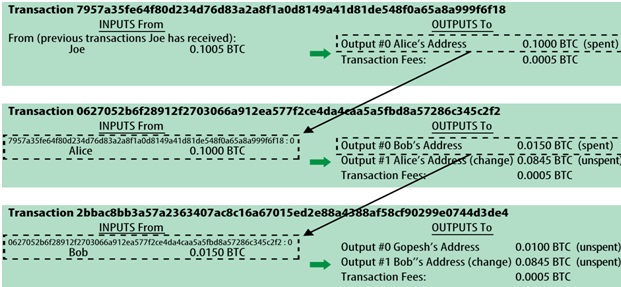
Outputs from one transaction can be used as inputs for another transaction. This creates a chain of ownership as the bitcoin value is moved from address to address.

Image titleFigure 1: Bitcoin Transaction Chain

Transaction Validation

All digital cash transactions also need to be checked and verified for authenticity, duplicity, and cash availability. The validation of the transactions is not centralized and all participating nodes are authorized for it.

A Bitcoin Wallet account that initiates a payment transaction is identified by a Bitcoin address and a pair of public and private keys. To enable verification of the sender identity, transactions are digitally signed using the sender’s private key and validated using his public key that is available to all the nodes.

The Bitcoin system orders the transactions into lists called blocks. These are subsequently linked to form a blockchain, a shared public ledger of all confirmed transactions. Transactions not yet included in the blockchain are unconfirmed and reversible.

The miners confirm and write these transactions into the blockchain. To prevent double-spending, a transaction is not marked confirmed until it has received a certain number of confirmations.

Each bitcoin mining node keeps a personal copy of the BlockChain which is updated whenever a new transaction arrives. This article explained that GPU is also a very efficient tool for the speedy mining of bitcoins. Subsequently, it also tries to validate the current and previous transactions in the block by solving a mathematical puzzle called the Proof of Work. The successful node that solves the puzzle gets a Bitcoin reward and its BlockChain approved and accepted by all nodes.

The Bitcoin Protocol

In terms of the transaction creation and validation process, the Bitcoin Protocol can be stated as below:

  • A new transaction is broadcast to all participating nodes in the network.
  • Each node collects new transactions into a block.
  • Each node tries to validate the new transaction and all previous ones by finding a solution to the Proof of Work for the block.
  • The node which finds the solution broadcasts the solved block to the network.
  • Nodes validate the transactions in the block and accept the block.
  • Nodes start working on the next block. A hash of the last accepted block is created and used as a reference in the next block.

Summary

The Bitcoin protocol is based on collaboratively maintaining the Bitcoin ledger. The digital cash is transferred through transactions which are confirmed only after validation of key criteria and joint consensus by participating nodes through a mathematical puzzle based voting process.

Sunday, January 31, 2021

Bitcoin and JUnit

 Source: https://dzone.com/articles/bitcoin-and-junit

Bitcoin and JUnit

Here's a solid guide to help you test your Bitcoin-centric projects with JUnit. See what it takes to set up and use a proper test environment.

· Java Zone · Tutorial

Bitcoin and blockchain are hot topics today. Many related projects are already out there and much more are being developed right now. If you are a developer in this area, then you know how important and tricky it is to have bulletproof testing in place. In this article, I will briefly describe the options for testing Bitcoin and then go into more detail of the choice that you can run easily and offline. Please note that this article is focusing purely on Bitcoin.

Testing Options

There are three possible modes or stages for testing Bitcoin applications.

  1. Regtest mode
  2. Test on the testnet
  3. Test on the mainnet

Regtest mode is what I would recommend starting with. It allows you to run the node on your local computer just as a sandbox, completely isolated from the internet. And it has one very useful feature. You are fully in control of the block generation, and new blocks can be 'mined' just by calling a simple command. This removes the need to wait for blocks to be mined. Also, you have an unlimited number of coins to play with because all the mining awards go to the account on your local node.

Testnet, as the name suggests, is a place that behaves almost the same as the real Bitcoin network. It is a fully functional network. This includes real mining, necessary waiting time, and a need to account for the activity of other people. The differences are that coins don't have any value, anyone can get a small number of free test coins, and the whole network gets nuked from time to time. It's a good next step after having a working system on the regtest.

Finally, mainnet is the network where the real transactions are happening. Bugs can become very expensive here, so it is better to leave this for the final test, after being confident that everything is working as planned.

I believe that during application development, you should walk through all three stages. The rest of this article will show how to connect regtest mode with JUnit. First, let's just get a little bit familiar with bitcoind, a program that implements the Bitcoin protocol and can act as a node.

Start with software installation. I prefer Bitcoin Unlimited. Download the latest version of the Official Bitcoin (BTC) Release for your platform and unzip/install it. Open the console and navigate to the folder with your binaries. A local node in the regtest mode can be started with the following command.


There are many parameters you can put into the command, and there is a reference guide here. The important ones are those that specify regtest mode, data directories, and open JSON-RPC ports for clients.

The next step is to open a second console, then navigate to the same directory, and use JSON-RPC client to perform actions. The following sequence generates blocks, sends coins to the specified address, and generates next set of blocks to simulate transaction progress in the chain.


If you have made it up to here, then you should be able to test your application and restart your chain from the beginning (by deleting the data directory) whenever you want. For the moment, though, that's all done manually. The next chapter will show you how to automate this.

An example project is available on the original post. It's a Java Maven project that contains a single unit test and that can be invoked from the command line just by mvn test. Bitcoin binaries for Windows are included. If you are using different platform, then please download and replace the binaries.

Coding is pretty straightforward and can be summarized in the following points:

  • Clean up the data directory and start the bitcoind process inside the test setup.
  • The tested client connects to the node during the test case as needed.
  • New blocks are generated on demand (there is a method for that).
  • The bitcoind process is stopped during the test teardown.

Note: Depending on your environment, you might need to deal with two issues — permissions and firewall.

Here is how you start the new bitcoind process.


The variable bcProcess is defined in the test class and is used in a teardown method to close the process. The 5-second thread sleep is trickier. processBuilder.start() returns immediately when the process is started. Unfortunately, the bitcoind process is not initialized at that point, so the connection would fail.

Next, how to stop the process.


That's the whole "magic". The rest of the code just cleans up the working directory before the test and invokes the actual test. For more details, please look at the source code.

Summary

As you can see, the Java code to run and interact with Bitcoin nodes is easy and it works. You can write test cases that run relatively fast and have a guaranteed environment. The portion that I don't really like is the dependency on the native program — especially while imagining handling multiple chains on the multiple systems. Then the number of necessary binaries can grow significantly. I have a couple of ways to resolve that in mind, but please let me know if you have an elegant solution for that.

Saturday, January 30, 2021

Blockchain: Why It’s So Much More Than Bitcoin

 Source https://dzone.com/articles/blockchain-why-its-so-much-more-than-bitcoin


Blockchain: Why It’s So Much More Than Bitcoin

The great promise of blockchain extends far beyond its role as a platform for the successful operation of Bitcoin and other cryptocurrencies. And yet, for some applications under consideration, technological challenges including performance and scalability will need to be addressed.

· Cloud Zone · News

There’s a new kid on the block of disruptive technology. Blockchain. A day doesn’t go by that you can’t find numerous articles about it. Topics range from how JP Morgan is making significant investments in exploring the technology, to the Republican GOP using blockchain to allow online voting in the recent Utah caucus.

It’s definitely a hot topic of discussion. At times, it sounds like blockchain is replacing Cloud in discussions as the technology panacea that will solve all problems. On the flip side, one of the first statements I invariably hear when blockchain enters the conversation with clients is, “We’re not interested in Bitcoin.” For many, the terms blockchain and Bitcoin are synonymous.

Blockchain ≠ Bitcoin!

In a recent weekend tweetchat (#CIOChat hosted by Myles Suer, a business strategist at Informatica), blockchain was the topic of discussion. One of the threads in the chat centered on the challenge caused by the blockchain/Bitcoin association. Ryan Fay, CIO at ACI Specialty Benefits said it best, “I can’t wait to start a conversation about blockchain and not spend an hour talking about Bitcoin.” This reflected the viewpoint of many in the chat.

The connection is understandable. If you do a Google search on blockchain, the top results inevitably pair the terms “blockchain” and “Bitcoin.” Blockchain technology originated in the establishment of Bitcoin. It enables digital currencies like Bitcoin to work.

A colleague of mine, Zach Slayton (VP of Digital Solutions at Collaborative Consulting) gave the analogy of fish and water. A fish (Bitcoin) needs water (blockchain) to survive. But water (blockchain) does not need the fish (Bitcoin). So while Bitcoin needs blockchain to work, blockchain doesn’t need Bitcoin to provide value.

(I’m not going to attempt to discuss the pros and cons of Bitcoin here. Those conversations can be almost as emotional as political discussions—and voluminous enough to fill books.)

What Exactly is Blockchain?

In simple terms, blockchain is a digital ledger. You can think of it as a spreadsheet. The blockchain ledger comprises a constantly growing list of transactions called “blocks”—all of which are sequentially connected. Each block has a link to the previous one in the list.

Once a block is in the chain it can’t be removed, so it becomes part of a permanent database containing all the transactions that have occurred since its inception.

One of the more interesting features about blockchain technology is that there’s no central authority or single source of the ledger. Which means it exists on every node that’s associated with it. Yes, every node has its own complete copy of the blockchain. As new blocks are added, they’re also received by every node that participates. Distributed consensus and trust ensures the integrity of the system.

Instead of Bitcoin, Think in Terms of Assets

If you look at blockchain through the lens of Bitcoin (or for that matter, cryptocurrency in general), it can provide a very limited view of blockchain’s business value and usefulness. If instead, we think of it in relation to assets of all kinds, we see a landscape of nearly boundless potential.

In her book, “Blockchain: Blueprint for a New Economy,” author Melanie Swan describes three categories of blockchain:

  • Blockchain 1.0 – Currencies. This includes currency transfers, remittances, and digital payment systems. This is the area most of us are familiar with as it is the territory of Bitcoin and other cryptocurrencies.
  • Blockchain 2.0 – Contracts. This extends blockchain into financial and marketplace applications. Assets include items such as bonds, stocks, loans, titles, and anything that has an implied agreement or contract.
  • Blockchain 3.0 – Organizing Activity. This takes blockchain out of the financial space and into areas such as education, government, health, and art. In these areas, asset types may be physical, digital, or human in nature.

In the second two categories, blockchain has far more potential than Bitcoin. And these applications are starting to garner significant interest throughout various industries.

Blockchain 2.0 – Contracts

The potential benefits (and disruption) presented by blockchain in the financial services industry has not gone unnoticed. As I mentioned at the beginning, JP Morgan is making significant investments in exploring blockchain. And many in the financial services industry are starting to take a serious look at blockchain technology and its potential impact.

  • Oliver Bussmann, CIO of UBS says that blockchain technology could “pare transaction processing time from days to minutes.”
  • Visa, Citi, and Nasdaq have invested $30M in the blockchain startup chain.com.
  • DTCC (Depository Trust & Clearhouse Corp.), recently held a symposium on blockchain titled, “Embracing the Disruption.” (DTCC acts as the trusted third-party clearing house for settling a majority of the securities transactions in the United States. Adoption of blockchain in the securities arena could cause a huge disruptive impact to their business model.)
  • In a recent article in Fortune Magazine, Christopher Giancarlo, a commissioner of the Commodity Futures Trading Commission expressed the view that blockchain could have helped save Lehman Bros. He said, “If an accurate [blockchain] record of all of Lehman’s transactions had been available in 2008, then Lehman’s prudential regulators could have used data-mining tools, smart contracts, and other analytical applications to recognize anomalies. Regulators could have reacted sooner to Lehman’s deteriorating credit-worthiness.”

It is worth noting that Bitcoin has no place in any of those discussions. This is purely about leveraging the technological benefits blockchain may provide to solve real-world business issues in the financial services sector.

Blockchain 3.0 – Organized Activity

Outside of the financial arena , blockchain could be used in some very out-of-the-box scenarios that one might not consider at first. As noted earlier, the use of blockchain to enable online voting during Utah’s recent GOP primary is just one example.

This application of the technology clearly demonstrates the concept of distributed ownership. When I create my “vote asset” and it’s placed on the chain, I don’t own the chain but I do own my asset, which is my vote—and also a block in the chain. So every voter owns a block in the chain. These blocks become permanent records of each individual’s assets and are immutably validated by consensus on the chain.

With that concept in mind, it’s exciting to think about blockchain’s potential in sectors and industries like government, education, and healthcare—just to name a few.

  • In Estonia, the government is using blockchain to secure over 1 million electronic health records (EHR). It’s important to remember that patients own their individual EHR assets, the security and integrity of which are maintained within the blockchain. So rather than calling and relying on providers for record transferals, patients can transfer records themselves through the blockchain.
  • The United Kingdom’s chief scientific advisor recently published a report entitled “Distributed Ledger Technology—Beyond Blockchain.” In it, he states that the technology “can revolutionize services, both in government and the private sector.”
  • During the weekend #CIOChat tweetchat I mentioned earlier, the topic of blockchain’s potentially disruptive impact on education produced a lengthy chat that continued well beyond the weekend. Digital strategy advisor Stephen diFilipo, (Digital Strategy Advisor) Peter Salvitti (CTO, Boston College), and Joanna Young (CIO, Michigan State University) all raised points of disruption and impact including:
    • Proof of learning and achievements
      • Credentials validation
      • Transcript verification
    • The concept of micro-learning and micro-credentials
  • And in the world of the Internet of Things (IoT), IBM and Samsung jointly developed a proof of concept demonstrating a decentralized IoT telemetry system powered by blockchain technology.

We Have Miles to Go and Promises to Keep

The great promise of blockchain extends far beyond its role as a platform for the successful operation of Bitcoin and other cryptocurrencies. And yet, for some applications under consideration, technological challenges including performance and scalability will need to be addressed.

As with any technology, blockchain is a tool, not a destination. Ultimately, as technologists, our job is to help the business achieve its goals—and reach its destination—by leveraging tools that provide business value.

I count having blockchain in our toolbox as a net positive. Because as I’ve illustrated above, it’s so much more than Bitcoin. And I’m confident that as we progress forward, that association will slowly fade away.

Saturday, March 7, 2020

Non-existent changeset UUID.in Wordpress


I was trying to change the theme of my Wordpress site by choosing "Live Preview" on a theme that I recently installed.  Then I got this error message:
Non-existent changeset UUID


This error actually mean that the Wordpress Address (URL) is not the same with the Site Address (URL).  Login to your /wp-admin site.  Then on the left panel, select Settings - > General


I recently defaulted my website to https.  I had to change the WordPress Address to https too so that they match.

Scroll all the way down and hit the Save Changes button.


Return to the left panel, select Appearances -> Themes.  Select the desired theme or add a new one by clicking


After choosing the theme, click "Live Preview"

You should be able to see the theme with your Wordpress settings and contents.


Once happy, click on the "Activate & Publish" button on the top left portion of the screen.

Tuesday, August 27, 2019

Microservices Interview Questions and Answers for Beginners and Experienced

Source: https://www.janbasktraining.com/blog/microservices-interview-questions/

Q1). What are the advantages of Microservices Architecture?

Here are a few advantages of Microservices architecture that you should know.
  • All microservices can be developed independently.
  • Once they are developed, they are deployed independently for a particular application.
  • Even if one of the services will not work, the system still continues to work.
  • Different technologies or languages in Microservices can be used to build multiple services of an application.
  • You can scale individual component one by one instead of scaling all components together.

Q2). How will you define the concept of Microservices?

In an architectural style, Microservices structures an application as a collection of small autonomous services that are modeled around a business domain. They usually start with a small block and can be arranged together to build a larger application. These cells then will be arranged in a pattern that will structure a stronger section of beehive later.
Each cell is connected but independent in its own way that can be scaled based on the requirements. It means damage to one cell will not affect the productivity of another cell. In this way, damaged cell can be reconstructed quickly and an application would behave the same way.

Q3). What are the Features of Microservices?

  • Services within a system can be largely decoupled. So, an application as a whole can be built quickly.
  • Each microservice is considered as an individual component and it can be replaced or reconstructed quickly.
  • Microservices are quite easier and simpler. They usually focus on one capability at a particular time.
  • Developers and teams can work independently, thus increasing the speed.
  • It allows the frequent release of a software application through systematic operations.
  • Microservices consider applications as a product for which they are responsible.
  • They are usually able to identify the right tool for the right job. It means there is no standardized pattern and you may choose the best useful tools as per your convenience.
  • Microservices follow the agile development and it can be developed quickly and discarded again.

Q4). When designing Microservices, what are best practices to follow?

Here are the best practices that every developer should follow when designing Microservices.
  • The data store should always be kept separated from each Microservice.
  • The code should be arranged at a similar level of maturity.
  • A separate build should be designed for each Microservice.
  • Each build should be deployed into containers.
  • The server should always be treated as stateless.

Q5). Explain the major components of a Microservices Architecture.

The major components of a Microservice architecture are given as below.

  • Clients: Different users will send requests from different devices.
  • Identity Providers: They will authenticate user details and offer service tokens to users.
  • Static Content: It helps in storing all the content of a system for longer time.
  • API Gateway: This gateway handles multiple requests together.
  • Management: it will balance the services over nodes and identifies failures as well.
  • CDNs: The content delivery network is a distributed network of proxy servers and their respective data centers.
  • Service Discovery: it will find the route how different Microservices communicate together.
  • Remote Services: it will enable the remote access to information stored on a network or other IT devices.

Q6). List down the pros and cons of a Microservice Architecture.

What are the pros?
  • It has the freedom to use different technologies.
  • Each Microservices will focus on single capability only.
  • It supports individual deployable units.
  • It allows frequent releases of a software application.
  • It gives maximum security to each of the services.
  • It is possible developing and deploying multiple services together.
What are the cons?
  • The troubleshooting challenges will increase.
  • It will increase delays due to remote calls.
  • The configuration options are not possible to manage.
  • It is difficult to maintain transaction safety.
  • Data cannot be tracked across different boundaries.
  • There is a tough coding between multiple microservices.

Q7). Are there any challenges faced during Implementation of Microservices Architecture?

They are tough automating components as they are very small. For each component, you have to follow stages – Build, Deploy, and Monitor. When a large number of components are deployed together, they become difficult to be deployed and maintained.
Here, it needs more perceptibility around components. It is tough maintaining configuration sometimes across multiple environments and also to identify bugs in each of the services. So, you have to be extra careful here.

Q8). How SOA, monolithic, and Microservices Architectures are different from each other?

  • SOA (Service-Oriented Architecture): This is a wide collection of services that could communicate together.
  • Monolithic: This is highly similar to the big container where all software components of an application are assembled and packed together.
  • Microservices: Microservices can be defined as the architectural style that structures an application as a collection of small autonomous services that are modeled around a business domain.

Q9). How will you define the domain driven design?

A domain-driven design focused more on core domain logic. It helps to identify complex designs on models of the domain. It can constantly collaborate with domain experts to improve the domain model and resolve all issues related to the domain.

Q10). Why there is a need for DDD (Domain Driven Design)?

A domain-driven design is necessary for the following reasons.
  • Maintainability and Testability
  • Reducing Complexity
  • Knowledge-Rich Designs
  • More focused on context
  • Following the ubiquitous language
  • Mapping with domains.
  • Bringing business and domains together.

Microservices Interview Questions and Answers for Experienced

Q11). How can you define the Ubiquitous Language for Microservices?

This is a specific language that can be used by developers or users to define every domain in detail. This is a crystal-clear language that brings all the team members together on the same page and translated so well that a machine can understand quickly.

Q12). How will you define coupling?

The measure of the strength of dependencies among components is said to be coupling. For a good design, cohesion is high and coupling is low.

Q13). What is the meaning of Cohesion in Microservices?

The degree to which how components bind together within a module is called the Cohesion.

Q14). What is the meaning of Spring Boot?

Spring becomes more and more complex when new features are added to an application. When you have to start a new Spring project, you should add paths and dependencies. Also, you have to define the configuration for servers, and define everything from scratch.
Spring Boot is the solution to this problem. With this feature, you can always avoid the boilerplate code and tough configurations. Basically, Spring is like an ingredient here that is needed to make a cake and Spring Boot is the complete cake in your hand.

Q15). What are RESTful web services and explain their benefits too?

RESTful web services or Representation State Transfer web services can be defined as the architectural style helping computer systems to communicate together over the internet. The REST web services make it easy to understand and implement the Microservices.
Microservices can always be implemented with or without REST APIs. For easy implementation, this is always recommended using REST APIs.

Q16). What is Spring Cloud?

This is a tool for the developers helping to quickly build some of the common patterns within distributed systems.

Q17). How will define an actuator in Spring Boot?

It helps in checking the current state of an application within the production environment. With the help of actuators, it is always easy monitoring matrices and checking your application.

Q18). What problems can be solved with the Spring Cloud?

Here are a few issues that can be resolved with the Spring Cloud.
  • It reduces the complexity associated with distributed systems.
  • It is able to handle service delivery.
  • It can solve redundancy issues too.
  • It helps in load balancing.
  • It reduces performance issues.

Q19). What are different types of tests for Microservices?

These are – Technology-facing tests, Exploratory Testing, and Acceptable Testing.

Q20). How will you define the Distributed Transactions?

This is the situation where a single event results in the mutation of two or more sources of separate data that cannot be committed automatically.